
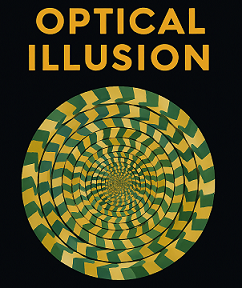
Our brains work fast to make sense of what we see. But sometimes, they can be fooled. Optical Illusions happens when what your eyes see and what your brain understands don’t match. These mind-bending visuals reveal how our brain processes shapes, colors, and movement. Understanding them gives insight into how perception works and why our senses can deceive us.
What Is an Optical Illusion?
An Optical Illusion is a visual trick. It makes you see something that isn’t really there or interpret it the wrong way. Your brain combines signals from your eyes and creates an image that may differ from reality. These illusions show how perception depends on context, light, and previous knowledge.
Optical illusions aren’t just fun puzzles. Scientists use them to study how the brain processes vision, attention, and depth. Every illusion tells us something new about human perception.
How the Brain Creates Optical Illusions
Your brain doesn’t just record images. It interprets them. When your eyes send visual signals, your brain tries to fill in the missing details. Optical illusions happen when this process goes wrong—or shows shortcuts.
Steps of visual interpretation:
- Light enters your eyes and hits the retina.
- The retina converts light into electrical signals.
- These signals travel through the optic nerve to the brain.
- The brain analyzes shapes, colors, and movements.
- It builds a complete picture based on past experience.
Sometimes, these patterns or assumptions confuse the brain. The result: an Optical Illusion.
Types of Optical Illusions
There are several main categories. Each works by confusing a different part of your visual system.
1. Literal Illusions
These show images that look different from reality. For example, you might see one image that can also be seen as another object.
2. Physiological Illusions
These are caused by overstimulation of the eyes. Bright lights, color contrast, or continuous patterns can make your visual system tired, leading to false perceptions.
3. Cognitive Illusions
These use brain assumptions. Your knowledge, expectations, and surroundings influence how you see patterns or shapes.
Why Your Brain Gets Tricked
The brain loves shortcuts. It doesn’t process every detail separately. Instead, it uses context and patterns. These assumptions help you react faster to the world—but they also create errors in perception.
Common reasons illusions happen:
- Perspective: Your brain judges size based on distance.
- Light and shadow: The brain interprets light as depth.
- Color contrast: Nearby colors change perception.
- Movement: Static images may appear to move.
- Pattern repetition: Repeating shapes confuse depth judgment.
The Science Behind Optical Illusions
Neuroscience explains that optical illusions exploit how visual neurons process data. Your eyes each view slightly different angles. The brain merges both to form 3D depth. When images have conflicting cues, the brain misreads them.
Color processing also plays a role. Cells in your eyes called cones detect red, green, and blue light. When certain colors are missing or combined unnaturally, your brain “guesses” the shade—often incorrectly.
The Power of Context
Context matters. When you see an object surrounded by shadows, your brain assumes it’s farther away. When the same object appears in light, it seems closer. That’s why an Optical Illusion can appear different when backgrounds or angles change.
A perfect example is a checkerboard shadow illusion. Two squares of the same color look different because of the surrounding lighting cues. Change the context, and the illusion vanishes.
Famous Optical Illusions Explained
Let’s explore some of the best and most fascinating examples.
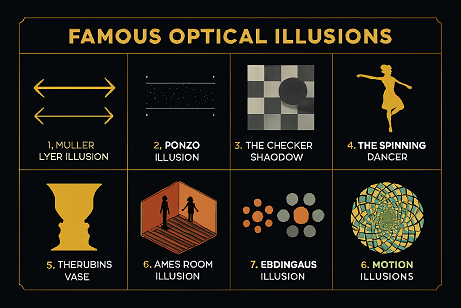
1. Müller-Lyer Illusion
Two lines of the same length appear unequal because of arrow-like endings. One line ends with inward arrows, and the other with outward arrows. The brain interprets perspective, assuming one line is further away.
Why it happens: The brain reads the image as a 3D structure. Depth cues make the lines look like edges of buildings or corners.
2. Ponzo Illusion
The Ponzo illusion shows two horizontal lines between converging lines, like train tracks. The upper line seems longer.
Reason: Your brain uses perspective to assess distance. Because the lines converge, it assumes the top line is farther away and must be larger.
3. The Checker Shadow Illusion
This illusion features a shadow cast on a checkerboard. Two squares of identical shade appear different because the brain compensates for lighting effects.
Science behind it: The visual cortex adjusts brightness to maintain consistent object color under changing light.
4. The Spinning Dancer
A silhouette of a dancer appears to spin clockwise or counterclockwise. The illusion happens because the image is ambiguous and lacks depth cues.
Explanation: Your brain switches between two 3D interpretations since both are valid.
5. The Rubins Vase
You may see either a vase or two human faces looking at each other. This illusion reveals how your brain alternates between figure and background perception.
Why it’s powerful: It shows that perception is selective—you can’t see both at once.
6. Ames Room Illusion
A trapezoidal room makes people appear to change size when they move across it.
Reason: The brain assumes the room is rectangular and applies normal size-distance rules. The warped shape breaks those assumptions.
7. Ebbinghaus Illusion
A central circle surrounded by small circles looks larger than the same circle surrounded by big ones.
Why: Relative size cues trick your perception of scale. The brain compares nearby objects instead of absolute size.
8. Motion Illusions
Static images appear to move in patterns. For example, rotating snakes or shimmering spirals create false movement.
Explanation: When bright and dark areas interact, your eyes make micro-movements. The brain misreads them as motion.
How Optical Illusions Affect Emotions
Optical illusions don’t just fool your eyes. They affect feelings too. Color contrasts and patterns trigger different emotional responses. For instance:
- Bright illusions can excite or amuse.
- Ambiguous figures can cause curiosity or surprise.
- Repetitive patterns might create discomfort.
These reactions show that Optical Illusions tie perception and emotion closely together.
The Connection Between Illusion and Art
Artists have always used illusions to create depth and emotion. Painters like M.C. Escher designed impossible staircases and endless patterns. These works rely on the same psychology as simple illusions.
Modern designers and architects also use these effects. They combine lines, light, and angles to make spaces look larger or textures appear deeper.
Optical Illusions in Everyday Life
We face small illusions every day. Shadows, reflections, and mirrors constantly reshape what we think we see. Even digital media uses them—for example, in 3D design, virtual reality, and augmented reality effects.
Here are daily examples:
- Rearview mirrors—objects look smaller but seem far away.
- Road markings—angled stripes help drivers slow down subconsciously.
- Advertising graphics—use shadows and highlights to enhance depth.
Why Optical Illusions Are Important in Psychology
Optical illusions help scientists understand visual and cognitive processes. They show how memory, attention, and learning influence what we see.
Research uses include:
- Studying visual disorders.
- Understanding brain flexibility.
- Testing perception accuracy in children and adults.
These studies improve computer vision, design safety, and even robotic perception.
What Optical Illusions Teach Us
When we observe illusions, we learn that perception isn’t always truth. Our brains interpret signals based on habits and context. That means reality is partly a mental creation.
Key lessons:
- Vision depends on interpretation.
- Assumptions guide perception.
- Color and light can deceive easily.
- Attention determines what we notice.
How to Enjoy and Learn from Optical Illusions
You can use Optical Illusions for both fun and learning. Here’s how:
- Study one illusion at a time.
- Note what your brain sees first.
- Observe how lighting or distance changes it.
- Discuss it with others to compare perceptions.
- Read about the scientific explanation afterward.
Practicing this improves your visual awareness and focus.
Tips for Creating Simple Optical Illusions
Creating your own illusion is easier than you think. Try simple experiments with shapes and colors.
Ideas to try at home:
- Draw parallel lines with inward or outward arrows to see the Müller-Lyer effect.
- Use alternating black and white circles to make movement illusions.
- Sketch overlapping shapes with shaded edges for depth confusion.
- Create patterns using warm and cool colors for contrast illusion.
Such DIY illusions help you understand how the eyes and brain relate.
Optical Illusions and Technology
Today’s AI tools and virtual reality systems often rely on Optical Illusion principles. They use depth cues and lighting to simulate real-world scenes. Machine learning models even study human perception to create better image recognition systems.
Optical Illusions inspire innovation in:
- Virtual reality simulation.
- 3D design technologies.
- Gaming and digital animation.
- Medical imaging interpretation.
These links show how understanding vision science benefits technology and education alike.
Can Everyone See Optical Illusions?
Most people can experience Optical Illusions, but reactions vary. Your age, focus, and even mood affect how you interpret patterns.
Children may see illusions differently because their perception is still developing. Artists and trained observers might notice details others miss.
However, individuals with certain visual or neural differences perceive illusions uniquely—and studying these differences improves understanding of both brain and vision.
How to Train Your Brain Using Optical Illusions
They can be more than entertainment. Repeated exposure helps boost focus, observation, and creativity.
Ways to use them for mental growth:
- Analyze how your perception changes.
- Try drawing or designing your own illusions.
- Play visual puzzles that rely on illusions.
- Practice critical observation instead of assuming details.
This strengthens both concentration and imagination.
The Future of Optical Illusion Research
New imaging techniques like fMRI and brain mapping allow scientists to see exactly which brain parts activate during an illusion. These studies could reveal deeper truths about human consciousness and visual learning.
AI systems are also learning to recognize and simulate illusions. This could lead to smarter vision systems, improved robotics, and safer driver-assistance tools.
Key Takeaways
- Optical Illusions reveal how vision and perception work.
- They show the brain’s shortcuts and creative interpretations.
- Different types—literal, physiological, and cognitive—confuse the visual system in unique ways.
- Famous examples like the Müller-Lyer and Ponzo illusions highlight how light, shape, and context influence perception.
- Studying illusions improves understanding of human psychology, art, and technology.
Action Plan
- Observe carefully: Look at famous Optical Illusions and note your reaction.
- Reflect on perception: Ask why your brain interprets images that way.
- Study scientific reasons: Learn how neurons and visual cortex contribute to these tricks.
- Apply insights: Use illusions for creativity, design, or teaching.
- Stay curious: Explore how Artificial Intelligence and psychology uncover new aspects of human vision.
By understanding how Optical Illusions work, you not only train your brain but also appreciate the fascinating link between science, art, and reality.