
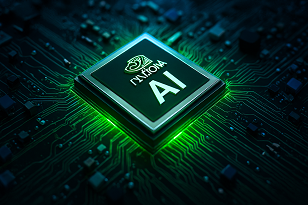
NVIDIA stands at the heart of the modern AI revolution. Its advanced GPUs now power everything from massive cloud servers to frontier AI models. In 2025, NVIDIA became more than a chipmaker — it became the currency of AI computing. This article explores how NVIDIA built this moat, what drives its demand, and what could challenge its dominance next.
The Rise of NVIDIA’s AI Dominance
NVIDIA transformed from a gaming chip pioneer into the central force of artificial intelligence infrastructure. Its GPUs, originally built for rendering graphics, turned out to be perfect for deep learning. These processors handle thousands of small tasks in parallel — a key requirement for AI model training.
- NVIDIA’s GPU dominance began in research labs.
- AI companies like OpenAI and Anthropic rely heavily on chips.
- Cloud leaders — Amazon, Google, and Microsoft — buy its accelerators in bulk.
Now, NVIDIA’s AI chips are the backbone of cloud computing and data center growth.
AI Accelerators: The New Cloud Currency
Cloud platforms run on massive computing farms. Training next-generation AI models takes vast amounts of computation. That computation now depends almost entirely on AI accelerators, led by NVIDIA’s H100 and upcoming B100 GPUs.
In this economy, chips are not just components — they are currency.
- Hyperscalers trade cloud credits for compute access.
- AI labs compete fiercely for GPU allocation.
- Access to NVIDIA accelerators defines who can train the next big model.
This GPU-driven economy reshaped the balance of power across global tech.
The Demand Flywheel Effect
NVIDIA’s growth follows a powerful demand flywheel. More AI model training means more GPU demand. More GPUs mean faster training, leading to better models — and even more demand.
- Cloud companies expand data centers using NVIDIA GPUs.
- AI startups and enterprises lease these GPUs through cloud services.
- Developers optimize software for CUDA and TensorRT, deepening NVIDIA reliance.
The cycle repeats, accelerating the company’s dominance and market capitalization.
This feedback loop makes NVIDIA’s moat wider each year, creating a self-reinforcing advantage.
Software and Ecosystem Lock-In
NVIDIA’s advantage is not only hardware. Its software ecosystem is a key barrier for competitors. CUDA, cuDNN, and its proprietary AI libraries lock developers into its platform.
- CUDA frameworks work best with NVIDIA chips.
- Developers trained on NVIDIA tools rarely switch to alternatives.
- Deep integration between hardware and software ensures top performance.
In effect, NVIDIA has created a sticky ecosystem like Apple’s iOS or Microsoft’s Windows. Competing chipmakers struggle to match not only its chips but the entire stack built around them.
Supply Chain Control and Strategic Positioning
Another pillar of NVIDIA’s moat is supply-chain mastery. The company works closely with TSMC (Taiwan Semiconductor Manufacturing Company) for cutting-edge production on 4nm and 3nm nodes. While NVIDIA designs, TSMC builds — and that relationship ensures technology leadership.
- Exclusive chip supply helps NVIDIA manage scarcity.
- Limited supply raises demand and maintains pricing power.
- Strategic allocation ensures premium customers get priority.
By controlling its supply chain dependencies better than competitors, NVIDIA keeps its GPUs scarce, valuable, and essential.
Customer Concentration Risk
Despite its massive growth, NVIDIA faces customer concentration risks. A few large tech giants — like AWS, Google Cloud, Microsoft Azure, and Meta — account for a large share of its revenue.
If one major hyperscaler reduces spending or shifts to in-house silicon, the impact could be significant.
- Dependence on a few buyers gives them negotiation power.
- Any shift in cloud strategy might affect NVIDIA’s pricing control.
- Long-term contracts can reduce flexibility during downturns.
Balancing this concentration while expanding into smaller enterprise markets remains a challenge for NVIDIA in 2025 and beyond.
Custom Silicon Threats
The biggest threat to NVIDIA’s future is custom AI chips from its own clients. Cloud leaders increasingly design their own accelerators to reduce dependence.
- Google has its TPU (Tensor Processing Unit).
- Amazon uses Trainium and Inferentia chips.
- Microsoft and Meta are developing in-house AI silicon.
These chips are not yet as flexible as NVIDIA’s GPUs, but they are optimized for specific workloads like inference and model serving. Over time, as open software standards rise, these custom chips may erode NVIDIA’s pricing advantage.
However, NVIDIA’s breadth — one platform for training and deployment — still provides unmatched flexibility. The company remains central to frontier model training even as inference shifts elsewhere.
Export Controls and Geopolitical Pressure
Geopolitics may become NVIDIA’s next big risk. U.S. export controls limit the shipment of advanced AI chips to countries such as China, restricting a major revenue source.
- The U.S. government enforces strict GPU export rules.
- Deep learning labs in China face limits on AI chip imports.
- NVIDIA created modified versions like the H800 to comply.
While NVIDIA adapts quickly, regulatory uncertainty slows sales growth and increases supply chain complexity. Global AI competition means such controls could tighten, challenging its expansion in Asian markets.
Architectural Shifts in AI Hardware
AI models evolve rapidly. The architectures driving them — transformers, diffusion networks, and multimodal systems — keep changing. NVIDIA must continually redesign chips to match these new computational needs.
Several possible architectural shifts could disrupt its GPU-first model:
- ASICs (Application-Specific Integrated Circuits): Purpose-built chips for AI tasks may outperform GPUs in efficiency.
- Quantum accelerators: Still experimental, but potential long-term GPU challengers.
- Neuromorphic computing: Promise lower power AI computations in the future.
If one of these technologies matures, demand for general-purpose GPUs could slow. NVIDIA’s continuous innovation cycle is critical to preserving its lead.
AI as the New Industrial Infrastructure
AI has become the infrastructure layer of the digital economy. Just as oil powered the 20th century, compute power fuels today’s innovation. NVIDIA’s chips sit at the center of this new supply chain.
- Cloud providers rent AI accelerators like utilities rent power.
- Research labs depend on NVIDIA scaling efficiency.
- Every frontier model — from GPT to Claude — needs its chips.
As the digital world moves from data to intelligence, NVIDIA’s role has become foundational. Its GPUs now define who can build and scale AI systems globally.
The Economics of Scarcity
Unlike traditional semiconductors, AI accelerators remain scarce. NVIDIA optimizes production, limiting supply to maintain pricing power.
- Demand far outstrips production in the data center segment.
- OEM partners face waiting lists for delivery.
- High prices flow through the entire cloud computing ecosystem.
This scarcity creates a luxury-market effect where GPUs become status symbols for AI labs. Controlling that supply gives NVIDIA immense strategic influence.
Competition on the Horizon
Competition is rising across all fronts — from chip architecture to software frameworks. Startups, legacy semiconductor firms, and even governments want to break NVIDIA’s hold.
Emerging rivals include:
- AMD: Catching up with MI300 accelerators and ROCm ecosystem.
- Intel: Investing heavily in Gaudi AI chips.
- Cerebras, Graphcore, and Tenstorrent: Target specialized AI workloads.
While capable, most of these alternatives struggle with software maturity and ecosystem depth. NVIDIA’s moat is wide but not invincible.
Strategic Adaptation: NVIDIA’s Long Game
NVIDIA understands these threats. It’s expanding beyond AI chips into full-stack platforms, data center networking, and cloud services.
- The NVIDIA DGX Cloud offers AI as a managed service.
- NVLink and InfiniBand networking improve compute integration.
- The Grace Hopper superchip combines CPU and GPU domains.
These moves reduce reliance on hardware margins and build deeper enterprise relationships. The company’s vision is to own not just chips, but the entire AI data pipeline.
Potential Disruptions Ahead
Despite its strength, three disruption scenarios could reshape NVIDIA’s outlook:
- AI Efficiency Revolution: Smaller, cheaper models reduce GPU demand per training run.
- Open Source Hardware: Communities develop open AI accelerators with non-proprietary toolchains.
- Economic Slowdowns: Reduced AI funding cuts into hyperscaler capital spending.
Adapting quickly to these macro and technical changes will define how long NVIDIA stays on top of the AI hierarchy.
Lessons from NVIDIA’s Moat Strategy
NVIDIA’s success shows that true dominance in tech comes from integration, not isolation. The company built a full-stack ecosystem that connects hardware, software, and services under one architecture.
Key elements of the NVIDIA moat include:
- Technical leadership through constant innovation.
- Strong lock-in via developer tools and CUDA ecosystem.
- Strategic scarcity and production control.
- Long-term alliances with hyperscalers and AI model creators.
Its strategy ensured that innovation in AI translates directly into demand for its hardware.
The Future of AI Compute Power
Looking ahead, compute power will continue to define competitive advantage. Nations and corporations alike are racing to secure GPU supply as a form of strategic resource.
In this environment:
- Access to NVIDIA GPUs equals access to AI supremacy.
- Investment in alternative chips will rise globally.
- Energy consumption and sustainability pressures may force efficiency breakthroughs.
AI’s next growth phase will blend competition, collaboration, and geopolitical tension — with NVIDIA at the core of every discussion.
Action Plan and Key Takeaways
Action Plan:
For technology leaders and investors watching this space:
- Track NVIDIA’s quarterly GPU allocations to big clouds.
- Monitor competitor roadmaps (AMD, Intel, custom silicon).
- Invest in software ecosystems interoperable with multiple accelerators.
- Follow export regulation trends shaping global AI hardware flows.
Key Takeaways:
- NVIDIA turned its GPUs into the new currency of cloud AI.
- Control over supply, software, and demand feedback creates its powerful moat.
- Custom silicon and export controls pose real challenges ahead.
- The company’s next chapter lies in expanding from chips to entire AI infrastructure stacks.
NVIDIA’s story is not just about chips; it’s about how computing became capital — and how one company minted the gold behind today’s AI boom.