
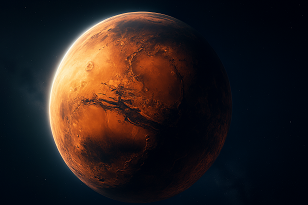
The dream of reaching Mars has fascinated scientists, space agencies, and space enthusiasts for decades. However, despite rapid progress in technology, the truth is clear: we are still not ready for Mars. While spacecraft can reach the red planet, human survival there remains uncertain. Mission planners, astronauts, and engineers still face immense obstacles that are far from being fully resolved.
Mars may be the next frontier, but before humanity launches a manned mission, we must face the truth. There are three major challenges that no one has completely solved yet — radiation exposure, sustainability of life support, and psychological strain on the crew. Understanding these problems is crucial because they will determine the success or failure of any long-term human presence on Mars.
Why Mars Captures Human Imagination
Mars stands out as the most Earth-like planet in our solar system. It has days similar in length to Earth’s, visible polar ice caps, and evidence of ancient rivers and lakes. Space agencies like NASA and private companies such as SpaceX are working toward sending humans there within a few decades.
However, dreaming of colonizing Mars and actually living there are two entirely different things. Continuous progress has been made in rocket technology, but biological and environmental challenges remain unsolved. Every successful Mars mission will require overcoming brutal realities — deadly radiation, extreme cold, thin atmosphere, and dangerous isolation thousands of kilometers away from home.
1. Radiation: The Invisible Threat No One Has Beaten
Radiation on Mars is the biggest obstacle standing in the way of human exploration. Earth’s atmosphere and magnetic field protect us from most cosmic rays and solar radiation. It lacks both, leaving the surface exposed to dangerous levels of radiation.
Understanding Mars’ Harsh Radiation
Radiation comes mainly from:
- Galactic Cosmic Rays (GCRs)
- Solar Energetic Particles (SEPs)
- Secondary radiation from impacts with the Martian soil
Exposure to this radiation over time can cause cancer, damage DNA, and weaken immune systems. Even during short missions, astronauts would receive doses that exceed safe lifetime limits.
Why Shielding Is So Hard
Although lead or thick materials could block radiation, carrying such heavy shielding to Mars is not practical. Engineers have proposed several alternatives:
- Using Martian soil (regolith) to build habitats that block radiation
- Underground bases or lava tubes for natural protection
- Hydrogen-rich materials like water or polyethylene for lightweight shielding
However, none of these methods have been tested on Mars itself. Moreover, solar particle storms can release bursts of radiation far more powerful than expected. Without real-world data, predicting survival rates remains uncertain.
Transitioning Toward Safer Missions
Before sending humans to Mars, scientists must create:
- Reliable radiation detectors
- Predictive warning systems for solar flares
- Portable shelters for emergency protection
Until these are perfected, radiation continues to be an unpredictable danger that could put astronauts’ lives at serious risk.
2. Life Support and Sustainability: Keeping Humans Alive on Mars
Even if radiation could be managed, staying alive on Mars poses another massive challenge. The Martian atmosphere has 0.13% oxygen, compared to Earth’s 21%. Temperatures can drop below -100°C, and there is no liquid water on the surface. Humans will need complete dependence on artificial systems to survive.
The Oxygen and Water Problem
NASA has developed experimental technologies like MOXIE (Mars Oxygen In-Situ Resource Utilization Experiment), which produced oxygen from Mars’ carbon dioxide atmosphere. However, these systems are still small-scale tests. For long-term missions, we would need systems capable of producing enough oxygen not only for breathing but also for rocket fuel.
Water can be extracted from underground ice or atmosphere condensation, but purification and storage at large scales remain unsolved.
Food Production Challenges
Transporting food from Earth is impossible for long-term colonization. Therefore, Mars settlers must grow food there. This introduces complex issues:
- Lack of natural soil nutrients
- High radiation may affect plant genetics
- Need for artificial lighting or enclosed greenhouses
Hydroponic or aeroponic systems could help, but sustaining them for years without resupply remains speculative.
Waste Recycling and Energy Production
Energy generation is another survival necessity. Solar power is weaker on Mars, and dust storms can block sunlight for weeks. Nuclear power offers stability, but safety and waste management complicate things.
Sustainable living will demand perfect recycling systems. Every drop of water, every breath of air, and every scrap of waste must be reused efficiently. Current International Space Station systems offer partial models, but operating them millions of kilometers away adds new risks.
Transition Toward Independence
Future missions need:
- Closed-loop ecosystems for air and water
- Compact food production modules
- Hybrid power systems combining solar and nuclear energy
Until a self-sustaining habitat is built, long-term survival will remain only theoretical.
3. Psychological and Social Challenges: The Silent Barrier
Even if technology could solve radiation and life support issues, the human mind presents another critical frontier. Astronauts on a Mars mission would face extreme isolation and long periods of confinement. Unlike the International Space Station, which orbits just a few hundred kilometers above Earth, Mars is millions of kilometers away.
A one-way signal delay of 20 minutes or more makes real-time communication with Earth impossible. This isolation can severely affect motivation, teamwork, and mental health.
The Reality of Deep Isolation
Crew members would live in small, confined habitats for more than a year during the journey — and possibly several more while living on Mars. They must depend entirely on one another, with no quick escape.
Psychologists studying astronauts and researchers in Antarctica have noted possible effects:
- Heightened stress and anxiety
- Interpersonal conflicts
- Sleep disruption
- Cognitive fatigue
Even highly trained astronauts could experience emotional burnout and depression under these extreme conditions.
Artificial Communication Limits
While AI assistants and delayed messages can help, they cannot replace true human contact. Families would seem infinitely far away. Mental health programs will need to be constant, adaptive, and deeply personal to keep morale stable.
Building a Supportive Mars Culture
Future missions must integrate:
- Continuous mental health monitoring
- Training in emotional resilience and crisis handling
- Transparent leadership and communication practices
A Mars colony will only thrive if mental health receives as much attention as engineering systems.
What Happens If We Ignore These Problems?
If humanity rushes a Mars mission without addressing these three issues thoroughly, the consequences could be tragic. A single system failure—whether due to radiation sickness, habitat breakdown, or crew conflict—could mean mission loss and human fatalities.
Beyond lives lost, such a failure might delay space colonization for generations. For this reason, experts emphasize gradual testing. Robotic missions, Moon bases, and orbital habitats will act as stepping stones toward safer human travel.
Current Efforts Toward Solving the Mars Challenges
Despite these difficulties, significant progress is underway worldwide. NASA, ESA, and private agencies continue research on all three fronts.
Radiation Solutions
- Developing space weather predictive models to forecast solar activity.
- Testing lightweight radiation shielding materials in Earth orbit.
- Studying biological countermeasures, such as protective pharmaceuticals.
Life Support Experiments
- The Biosphere 2 and HI-SEAS simulations test how people manage closed ecosystems.
- ISRU experiments explore converting Martian resources into fuel and breathable air.
- Robotic precursors, like rovers, analyze soil for potential greenhouse cultivation.
Psychological Resilience Programs
- NASA conducts analog missions that simulate Mars conditions on Earth.
- Virtual reality environments help astronauts maintain mental stimulation.
- Autonomous decision-making programs reduce psychological stress from communication delays.
Could Technology Alone Make Mars Habitable?
Technology is vital but will not be enough on its own. True readiness for Mars will require harmony between engineering, biology, and psychology. The technology must serve human needs while respecting physical and emotional limits.
It is possible to imagine advanced systems—3D-printed shelters, robotic farmers, or self-repairing machines—but human adaptability remains uncertain. The human body evolved for Earth’s gravity and air; we still do not know how long we can perform under Mars’ gravity, which is just 38% of Earth’s. Over years, this may affect bone structure, muscles, and heart function.
Lessons from the Moon and the ISS
The Moon and the International Space Station (ISS) offer valuable lessons for Mars planning. The ISS provides data about long-duration missions in microgravity, resource recycling, and international teamwork. Yet, its proximity to Earth allows fast rescue and resupply — luxuries not available on Mars.
The lunar environment is harsher than Earth but closer than Mars, making it a perfect testing ground. Establishing a permanent Moon base could train crews and perfect systems before venturing further. Every successful experiment there reduces risk on Mars.
Ethical and Environmental Concerns
Mars colonization also raises ethical questions. Should humans introduce Earth microbes to another planet? Could this destroy potential native ecosystems or future life evidence? Scientists call this planetary protection — maintaining Mars’ environment uncontaminated.
Moreover, the mental health of astronauts brings moral obligations. No exploration achievement should come at the cost of irreversible harm to human health. Thus, careful planning and staged testing remain essential.
Can Mars Ever Be Home?
Even with all the challenges, Mars represents hope for humanity’s long-term survival. Living on multiple planets could protect civilization from global catastrophes. The red planet’s vast landscapes invite imagination and discovery. However, patience is key.
Before Mars can become a second home, humans must ensure it does not become a graveyard of failed dreams. The success of a Mars mission will depend not only on rockets and robots but also on foresight and empathy.
Action Plan: What Needs to Happen Before We Go
- Advance Radiation Protection:
Test and deploy hybrid shielding materials and real-time space weather alerts. - Perfect Sustainable Life Systems:
Build closed environments on the Moon or in orbit to practice recycling, food growth, and power storage. - Address Human Factors Deeply:
Establish continuous psychological support and emergency decision autonomy for crews. - Create Testing Milestones:
Use Moon missions and long-term orbital stays as preparation models. - Promote International Collaboration:
Pool global expertise so Mars missions benefit from diverse strengths.
Every step taken today narrows the gap between dream and reality.
Key Takeaways
- Mars remains humanity’s most achievable planetary destination, but critical challenges are still unresolved.
- The three biggest obstacles—radiation protection, sustainable life support, and psychological resilience—require long-term solutions, not quick fixes.
- Progress is steady but incomplete. Testing, adaptability, and global effort will decide when humans truly become interplanetary.
- Rather than rushing, we must prepare, simulate, and innovate, ensuring that the first footsteps on Mars mark a beginning, not an end.
Humanity’s destiny among the stars will begin not with a leap of blind ambition but with careful, patient readiness. The red planet awaits—but only those prepared to face its deepest challenges will survive to build a new world there.