
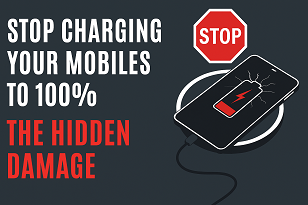
Do you always charge your mobile phone to a full 100%? Consequently, you might be accidentally damaging its battery. Most people believe that a completely full battery is the ultimate goal. However, this common practice is secretly shortening your device’s lifespan. Modern smartphones use Lithium-ion (Li-ion) batteries.
Therefore, their chemistry requires specific care. For instance, consistently maxing out the charge stresses the battery. This stress, in turn, leads to reduced capacity and performance over time. Ultimately, understanding this hidden damage is the first step toward preserving your mobile’s health.
Furthermore, the damage is often invisible at first. Your phone might seem fine for months. Meanwhile, its ability to hold a charge is slowly degrading. This article will explain the science behind battery wear. We will also provide simple, actionable tips. As a result, you can significantly extend your mobile’s battery life starting today.
The Science Behind Your Mobile’s Battery
To understand the problem, we must first look at the technology. Essentially, nearly every modern mobile device is powered by a Lithium-ion battery. These batteries operate on a simple principle: lithium ions move between a positive cathode and a negative anode. Subsequently, this movement creates the electrical current that powers your phone.
However, this process is not infinitely sustainable. Each charging cycle causes tiny, irreversible changes inside the battery. For example, high voltages, which occur when charging above 80%, accelerate this degradation. The battery’s components, such as the electrolyte, begin to break down. Additionally, metallic lithium plating can form on the anode. Consequently, this reduces the number of ions available for creating energy. The outcome is a battery that dies faster and holds less power.
Moreover, heat is a major enemy of battery health. Interestingly, charging your mobile to 100%, especially with fast chargers, generates significant heat. This heat, combined with high voltage, creates a perfect storm for battery damage. Therefore, managing both charge level and temperature is crucial.
Why 100% Mobile Charge is the Enemy
You might think a full charge means maximum power and convenience. Conversely, it actually puts your mobile battery under immense strain. Let’s break down the primary reasons why.
- High Voltage Stress: A battery at 100% charge is at its peak voltage. This state of high pressure forces the battery’s internal chemistry to work harder. As a result, the materials in the cathode degrade much faster than they would at a lower voltage.
- Loss of Charging Cycles: Every battery has a limited number of full charge cycles. A charge cycle is defined as using 100% of the battery’s capacity. For instance, using 50% one day and 50% the next completes one cycle. By consistently charging to 100%, you are using up these precious cycles more quickly.
- Continuous Trickle Charging: Many people charge their phones overnight. Once the mobile hits 100%, the charger must maintain that level. Therefore, it uses a “trickle charge,” constantly topping off the battery. This continuous state of high stress is like keeping a rubber band stretched tight—it eventually loses its elasticity.
In short, keeping your mobile at maximum charge is akin to running an engine at redline constantly. It might work for a while, but the long-term damage is inevitable.
The Perfect Zone: Optimal Mobile Charging Range
So, if 100% is bad, what is the ideal charge level? According to battery experts and manufacturers, the sweet spot for a mobile battery is between 20% and 80%.
Here’s why this range is so effective:
- Reduced Chemical Stress: Within this band, the battery operates at a lower voltage. Consequently, the chemical reactions inside are much more stable and less damaging.
- Extended Cycle Life: A cycle from 20% to 80% puts far less strain on the battery than a cycle from 0% to 100%. In fact, studies show that avoiding the extremes can double or even triple the number of cycles a battery can endure.
- Practical Longevity: By following this rule, your mobile will maintain its original battery capacity for much longer. This means your phone will last through a full day on a single charge for years to come.
Think of it this way: you wouldn’t starve yourself until you’re famished and then eat until you’re sick. Similarly, your mobile battery thrives on moderate, regular “meals” rather than extreme feasts and famines.
Other Common Mobile Charging Mistakes to Avoid
Beyond charging to 100%, several other habits can harm your mobile. Therefore, it’s important to address these as well.
Firstly, avoid letting your battery drain to 0%.
Deep discharges are equally harmful. They cause undue stress on the battery’s internal structure. Consequently, this can lead to a state where the battery can no longer be recharged at all.
Secondly, be very cautious with heat.
As mentioned earlier, heat is a battery killer. Never leave your mobile in a hot car or in direct sunlight. Additionally, remove thick cases while charging to prevent overheating.
Thirdly, be mindful of using your phone while it charges.
This practice, especially for graphics-intensive tasks, generates significant heat. This combines the heat from processing with the heat from charging. The result is a dramatic acceleration of battery wear.
Actionable Tips for a Healthier Mobile Battery
Now that we understand the problems, let’s focus on solutions. Implementing these simple habits will dramatically improve your mobile’s battery health.
1. Adopt the 20-80 Rule.
Make this your golden rule for daily charging. Try to unplug your device once it reaches around 80%. Furthermore, plug it in before it drops below 20%.
2. Use Software and Hardware Aids.
- Enable Optimized Battery Charging: Both iOS and Android have built-in features that learn your routine. They will delay charging past 80% until you need to use your phone.
- Use a Smart Plug: You can use a Wi-Fi plug to schedule charging times. For example, you can set it to power on for just two hours to take your battery from 20% to 80%.
- Consider Slow Charging Overnight: If you must charge overnight, use a standard 5W or 10W charger instead of a fast charger. This generates less heat.
3. Manage Heat Effectively.
- Always charge your mobile on a hard, flat surface. Never on a soft surface like a bed or pillow.
- Take off the case during heavy charging sessions.
- Avoid placing it in hot environments.
4. For Long-Term Storage, Use a 50% Charge.
If you are storing a mobile device for weeks or months, do not leave it fully charged or empty. Instead, charge it to about 50%. This is the most stable state for a Lithium-ion battery and prevents degradation during inactivity.
Your Simple Mobile Battery Action Plan
Changing habits can be challenging. Therefore, here is a straightforward, step-by-step plan you can start today.
- Step 1: Check Your Settings. Go to your mobile’s battery settings and turn on “Optimized Battery Charging” or “Adaptive Charging.”
- Step 2: Change Your Charging Mindset. Stop seeing 100% as the goal. Instead, aim for 80% during the day. You can even set a charging alarm as a reminder.
- Step 3: Rethink Overnight Charging. If possible, charge your phone during the day in short bursts. For example, while you’re working at your desk or during your morning routine.
- Step 4: Be Heat-Aware. Make a conscious effort to keep your phone cool, especially during charging.
Key Takeaways
In conclusion, the way you charge your mobile has a profound impact on its longevity. To summarize the most critical points:
- Charging to 100% consistently causes high voltage stress and accelerates battery degradation.
- The optimal charging range for a mobile battery is between 20% and 80%.
- Heat is a primary enemy of battery health and should be managed carefully.
- Avoid deep discharges to 0% as they are equally harmful.
- Utilize built-in software features and smart charging habits to automate battery protection.
Ultimately, by shifting your charging routine, you are not just preserving battery life. You are also enhancing the long-term value and performance of your mobile device. Start today, and your future self will thank you for a phone that lasts.