
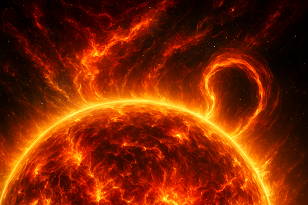
A massive solar storm recently sent shockwaves through Earth’s magnetic field, shaking power grids, satellites, and internet systems. Scientists warned that if it had been just a little stronger, modern life as we know it could have collapsed. Since everything from communication to healthcare depends on technology, the idea of losing electricity and digital systems is terrifying. Yet, the event also reminds us how vulnerable we are to forces beyond our control.
What Is a Solar Storm?
A solar storm happens when the Sun releases bursts of charged particles and radiation. These events are usually linked to solar flares or coronal mass ejections (CMEs).
- Solar flares are sudden flashes of energy from the Sun.
- Coronal mass ejections (CMEs) are huge explosions that hurl plasma and magnetic fields across space.
- Geomagnetic storms occur when these particles hit Earth’s magnetic field.
Together, these storms can disturb satellites, GPS systems, power grids, and internet cables.
The Solar Storm That Almost Sent Us Backward
The recent solar storm was one of the most powerful in decades. Space weather experts described it as a near-miss scenario.
- Power grid operators noticed unusual fluctuations.
- Airlines had to reroute planes to avoid communication blackouts.
- Internet connections showed signs of interruption in some regions.
Thankfully, the worst outcomes were avoided. Still, experts admitted that if it had been slightly stronger, electrical systems worldwide could have gone dark.
Why Solar Storms Are So Dangerous
Transitioning into how this affects daily life, we must look at how deeply modern society depends on technology.
- Most industries rely on electricity.
- Satellite systems control GPS, navigation, and weather prediction.
- The internet underpins finance, trade, healthcare, and social communication.
A powerful solar storm could disrupt all of these at once. In fact, scientists compare such risks to global natural disasters.
Lessons From History: The Carrington Event
To understand the scale, let’s revisit history. The largest solar storm ever recorded was the Carrington Event of 1859.
- Telegraph systems failed and even sparked fires.
- Operators received electric shocks.
- Auroras lit up skies worldwide, far beyond the polar regions.
If a storm of that scale hit today, the world would suffer unimaginable damage. Banks, airlines, hospitals, governments, and entire cities could lose access to vital technology.
How Solar Storms Impact Satellites
Because satellites orbit outside Earth’s protective atmosphere, they are some of the first systems to be affected.
- Radiation interferes with communication signals.
- Satellites can lose orientation.
- In extreme cases, they can be permanently damaged.
This means television, GPS, internet, and defense systems could all be disrupted. Transitioning from satellites to infrastructure helps illustrate the chain reaction solar storms can unleash.
Power Grids: The Weakest Link
Earth’s electricity grids are huge and interconnected, making them vulnerable to solar storm damage. When powerful geomagnetic storms hit, currents can surge through long power lines.
- Transformers can overheat and explode.
- Blackouts can spread across cities and countries.
- Restarting power grids could take weeks or months.
Since electricity is the foundation of every modern system, losing it for long periods could push society decades backward.
The Internet Blackout Threat
The internet, while powerful, has hidden weaknesses. Undersea cables link continents. A major geomagnetic storm could disturb these fragile systems.
- Local networks might survive, but global connections could fail.
- Banking and trade would stop.
- Emergency communication would be slowed.
In such a case, simple tasks like transferring files or calling a loved one overseas would suddenly vanish.
The Sun’s 11-Year Cycle and Risks Ahead
It is important to know that solar activity follows an 11-year cycle. During solar maximum, the Sun experiences more flares and CMEs.
- The current solar cycle is reaching its peak.
- The frequency of solar storms is increasing.
- Experts predict more disturbances in the coming years.
This means society must be prepared now, rather than waiting for disaster.
How Scientists Monitor Solar Storms
Scientists and space agencies monitor the Sun using satellites like NASA’s Solar Dynamics Observatory.
- They track solar activity in real time.
- Alerts are issued to governments and power companies.
- Early warning systems allow airlines and industries to prepare.
Although forecasts have improved, predicting the exact strength of a solar storm remains difficult.
Can We Protect Against Solar Storms?
Many governments and companies are taking measures.
- Power grids are being upgraded with protective shields.
- Satellites are designed with backup systems.
- Engineers are researching methods to harden undersea cables.
Still, challenges remain because preparing for every possible scenario is costly and complex.
Everyday Impacts If a Major Storm Hits
If a devastating solar storm struck, ordinary people would notice its impact instantly.
- Lights would go out in homes and cities.
- Planes could be grounded.
- Supermarkets would struggle with digital payments.
- ATMs and banks might shut down.
- Medical equipment could fail without backup power.
For this reason, experts often compare the scenario to “a modern dark age.”
How to Stay Prepared Individually
While most protection depends on infrastructure, people can take small steps.
- Keep a backup supply of water and food.
- Have flashlights and batteries stored.
- Use solar-powered chargers for essential devices.
- Print important information, since digital records may not always be accessible.
- Stay updated with government space weather alerts.
Transitioning from individual steps to global cooperation highlights the importance of both personal and collective resilience.
Why Global Cooperation Matters
Because solar storms affect the entire planet, no single country can manage them alone.
- Satellites are international resources.
- The global internet depends on interconnected systems.
- Power grids and aviation routes cross borders daily.
International cooperation in monitoring, research, and defense is essential to prevent technological collapse.
The Balance Between Risk and Hope
Although the idea of a massive solar storm is frightening, experts remind us that humanity is far better prepared today than in the past.
- Monitoring systems are stronger.
- Scientists share real-time data worldwide.
- Engineers constantly upgrade infrastructure.
Therefore, while risks exist, so do solutions. People should stay informed without panicking.
Action Plan for the Future
To reduce risks, experts suggest:
- Investing in stronger power grids.
- Building resilient satellite systems.
- Training emergency response teams.
- Educating the public about space weather risks.
- Encouraging cooperation between governments and industries.
These steps would greatly reduce the possibility of society experiencing a catastrophic blackout.
Key Takeaways
- A solar storm nearly disrupted modern systems on a massive scale.
- History shows us that powerful storms can happen again.
- Power grids, satellites, and the internet remain at highest risk.
- Global cooperation and preparation are crucial.
- Individuals can also take small steps to prepare.
Conclusion: The Sun’s Warning Shot
The latest solar storm was a wake-up call. It reminded us that even the most advanced technology remains vulnerable to nature’s raw power. Although we avoided disaster this time, the risks are real. With preparation, resilience, and cooperation, humanity can face the Sun’s challenges without being forced back into a new dark age.