
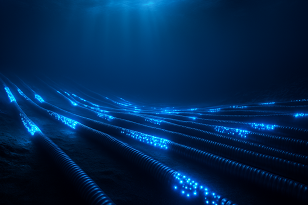
When people imagine the internet, they often think of satellites, Wi-Fi signals, and cloud storage. Yet, in reality, most of the internet depends on something hidden beneath the oceans: undersea cables. These fiber-optic lifelines carry over 95% of international data. Without them, video calls, online banking, and even international trade would stop. However, while these cables form the backbone of global connectivity, they come with lesser-known weaknesses that put our digital world at risk.
Table of Contents
- What Are Undersea Cables?
- Why the Internet Lives Under the Sea
- The Scale of the Global Network
- How Undersea Cables Work
- The Hidden Weaknesses of Undersea Cables
- Repairing Damaged Undersea Cables
- Who Owns the Undersea Cables?
- Geopolitics and Cable Security
- Undersea Cables vs Satellites
- Future of Undersea Cables
- Why Users Should Care
- Protecting the Secret Backbone
- Action Plan for Readers
- Key Takeaways
What Are Undersea Cables?
Undersea cables are long fiber-optic wires placed on the ocean floor. They link continents and transmit massive amounts of data at lightning speed.
- These cables stretch for thousands of kilometers.
- A single cable can be as thin as a garden hose.
- They transmit digital signals across countries and oceans.
Because they are faster and more reliable than satellites, undersea cables remain the true backbone of the internet.
Why the Internet Lives Under the Sea
At first glance, satellites may seem like the main players in global connectivity. However, undersea cables offer advantages that satellites cannot match.
- They deliver lower latency.
- They carry larger volumes of data with higher speed.
- They consume less energy compared to satellite systems.
This is why tech companies, governments, and telecom operators invest heavily in laying these cables. In fact, companies like Google, Meta, and Amazon now own or co-own a growing number of them.
The Scale of the Global Network</h2>
The global map of undersea cables looks like a massive web. Over 400 cables currently connect major parts of the world. Together, they stretch over 1.3 million kilometers.
Key facts about the network:
- The first transatlantic cable was laid in 1858, for telegraph messages.
- Today, cables connect nearly every continent except Antarctica.
- Some routes involve multiple parallel cables for added capacity.
This underwater network ensures that information flows instantly, turning our world into a real-time global village.
How Undersea Cables Work
The science behind undersea cables is both simple and fascinating.
- Fiber optics: Data travels as light pulses inside glass strands.
- Repeaters: Devices placed every 50-100 km boost signals to prevent loss.
- Landing stations: Cables end at coastal stations that connect to regional networks.
Because of fiber technology, undersea cables can transmit terabytes of data per second.
The Hidden Weaknesses of Undersea Cables
Despite their strength, undersea cables have hidden weaknesses. Unlike satellites in orbit, these cables lie exposed on the seabed. That makes them vulnerable to several risks.
Accidental damage
Fishing activity and ship anchors frequently cut undersea cables. Most cable faults happen in shallow waters near coastlines.
Natural events
Earthquakes, tsunamis, and underwater landslides can break cables. For example, a 2006 earthquake in Taiwan disrupted internet access across Asia.
Deliberate tampering
Cables are also potential targets for sabotage or espionage. Because they carry sensitive financial data and government communications, their security has become a major global concern.
Repairing Damaged Undersea Cables
When cables are damaged, repair ships are deployed. This process is complex and expensive.
- A ship locates the fault with sonar and undersea maps.
- A robot or grappling hook pulls the damaged section to the surface.
- Engineers replace or patch the broken part.
Repairs may take days or even weeks, causing major disruptions in global internet traffic.
Who Owns the Undersea Cables?
Ownership of undersea cables is split among several groups:
- Telecom companies build and maintain transoceanic links.
- Big tech firms like Google and Meta now control many of their own cables.
- Governments and alliances co-invest in certain projects for security reasons.
This mix of ownership raises questions about control, access, and digital sovereignty.
Geopolitics and Cable Security
Because these cables are critical infrastructure, they play a role in global politics.
- Nations compete to secure control over cable routes.
- Military forces track the safety of cables in their territories.
- Strategic choke points exist where multiple cables pass together, such as the Suez Canal and the South China Sea.
Such chokepoints create risks of surveillance and intentional disruption.
Undersea Cables vs Satellites
| Feature | Undersea Cables | Satellites |
|---|---|---|
| Speed | Lower latency | Higher latency |
| Capacity | Huge data volumes | Limited capacity |
| Cost | High installation, low long-term | Costly maintenance |
| Security | Vulnerable under oceans | Vulnerable in orbit |
Though satellites are useful for remote areas and backup, undersea cables remain the backbone powering our data-driven age.
Future of Undersea Cables
As the internet grows, undersea cables continue evolving.
- New materials will make them stronger and more flexible.
- AI monitoring systems will predict weak points before damage happens.
- Private sector growth will increase the number of new routes each year.
These improvements aim to reduce downtime and protect one of humanity’s most critical infrastructures.
Why Users Should Care About Undersea Cables
Most internet users never think about the infrastructure beneath the sea. Yet, every online activity depends on it.
- Video calls, emails, and social media all run on undersea cables.
- Financial systems, stock markets, and trade rely on their stability.
- Streaming services and cloud apps would slow or fail without them.
By knowing about these hidden lifelines, people can better understand digital vulnerabilities.
Protecting the Secret Backbone of the Internet
To reduce risks, governments and private companies follow certain measures:
- Building cable redundancy with multiple routes.
- Designing cables with stronger protection layers.
- Monitoring networks for unusual activity.
- Sharing intelligence on possible threats.
Stronger protection ensures that we can continue to enjoy seamless global connectivity.
Action Plan for Readers
While ordinary internet users cannot directly protect undersea cables, there are steps everyone can take to support system reliability.
- Support global awareness about digital infrastructure.
- Promote sustainable fishing to reduce accidental damage.
- Encourage governments to invest in cybersecurity and cable defenses.
Understanding these cables also empowers individuals to recognize how vital digital infrastructure is to modern life.
Key Takeaways
- Undersea cables carry over 95% of international internet data.
- They are faster and more efficient than satellite communication.
- Accidents, natural disasters, and sabotage are their hidden weaknesses.
- Protecting undersea cables is a geopolitical, economic, and technological priority.
- Everyone benefits when these secret lifelines are secured.
At the bottom of the sea lies the true nervous system of our connected world. Undersea cables may remain unseen, but they control almost everything about our digital lives. That makes protecting these fragile giants not just an engineering challenge, but also a mission for the future of global society.