
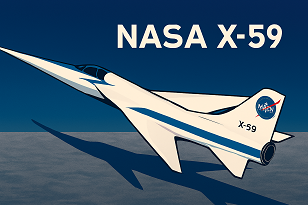
The “Silent” Sonic Boom: How NASA X-59 Could Cut Your Flight Time in Half
Imagine flying from New York to London in just three hours. This is the exciting promise of NASA’s X-59 QueSST aircraft. For decades, supersonic travel was grounded by a thunderous problem: the sonic boom. However, the NASA X-59 program is tackling this challenge directly. This research could lead to a new era of commercial flight. Therefore, your future flights might take half the time.
The Problem That Killed Supersonic Flight
The Concorde was a magnificent engineering achievement. It could cruise at twice the speed of sound. Despite its speed, it faced huge obstacles. Its sonic boom was incredibly loud. Consequently, regulators banned it from flying over land. This restriction severely limited its routes. Furthermore, its operating costs were very high. As a result, the Concorde retired in 2003.
The core issue was always the sonic boom. When an aircraft flies faster than sound, it creates pressure waves. These waves merge into powerful shockwaves. They reach the ground as a loud double bang. This is not just noisy. It is a public nuisance. Thus, the FAA prohibited overland supersonic flights. This rule made commercial supersonic travel impractical.
The NASA X-59 Mission: A Quieter Future
NASA’s X-59 QueSST is not a passenger plane. It is a flying laboratory. Its mission is to collect crucial data. Specifically, it will prove it can fly supersonically while producing a much quieter “thump.” This sound is what NASA calls a “sonic thump.” They hope it will be no louder than a car door closing.
The secret lies in its unique design. The NASA X-59 has a very long and slender fuselage. This shape is engineered to manage shockwaves. Instead of merging into a loud boom, the waves are spread out. Therefore, they arrive at the ground as a softened thump. Its cockpit is positioned halfway down the aircraft. This design eliminates the need for a forward-facing windshield.
How This Could Revolutionize Your Travel
The success of the NASA X-59 program has huge implications. If regulators accept the data, the overland ban could be lifted. Consequently, new commercial supersonic jets could be developed. These future aircraft would use this quiet supersonic technology. As a result, your travel experience would change dramatically.
Consider these potential flight time reductions:
- New York to Los Angeles: Currently 6+ hours; potentially just 3 hours.
- Tokyo to San Francisco: Currently 10+ hours; potentially just 5 hours.
- Sydney to Singapore: Currently 8+ hours; potentially just 4 hours.
This is not just about speed. It is about efficiency and connectivity. Businesses could have same-day meetings across oceans. Families could visit relatives with less time and jet lag. Essentially, the world would become much more accessible.
The Road Ahead: Testing and Public Perception
The path to quiet supersonic flight needs careful steps. NASA’s plan is both scientific and social. After initial tests, the NASA X-59 will fly over selected U.S. communities. The goal is to measure the sound levels. It also aims to gauge human reaction.
This public perception study is vital. Regulators like the FAA will need this data. They will ask residents for their feedback. Was the sound bothersome? Would they accept it regularly? Ultimately, public acceptance is as important as the engineering.
Your Action Plan for the Supersonic Future
While we await these flights, you can stay informed. This technology is coming, so understanding it is wise.
Key Takeaways and Actionable Steps:
- Stay Updated: Follow NASA’s official channels for the latest NASA X-59 news.
- Understand the Timeline: This is a multi-year program. Commercial flights are likely a decade away.
- Manage Expectations: The first flights will be premium services. However, costs should decrease over time.
- Appreciate the Science: The breakthrough is quiet operation over land. This unlocks practical supersonic travel.
In conclusion, the NASA X-59 represents a huge leap forward. It addresses the main barrier to overland supersonic flight. Therefore, it paves the way for cutting your flight time in half. This quiet supersonic breakthrough promises to shrink our world. The thunderous boom may soon be a gentle thump. It will herald a new age of aviation for everyone.