
Metabolic health is the cornerstone of how your body feels and functions every single day. It goes far beyond the number on a scale. When your metabolism is thriving, you experience steady energy, mental clarity, a strong immune system, and a powerful defense against chronic diseases. Unfortunately, in our modern world of processed foods and sedentary lifestyles, poor metabolic health has become the norm, leading to energy crashes, stubborn weight gain, and an increased risk for conditions like type 2 diabetes and heart disease.
The good news? You don’t need extreme diets or punishing routines to reclaim it. This article will guide you through the three foundational pillars of robust metabolic health—insulin sensitivity, muscle mass, and strategic meal timing—to help you achieve stable energy and lifelong wellness.
What is Metabolic Health, Really?
At its core, metabolic health describes how efficiently your body converts the food you eat into usable energy. It’s a measure of the effectiveness of all your metabolic processes.
A person is considered metabolically healthy when they have optimal levels of five key markers without the need for medication:
- Blood Glucose (Sugar): Stable, within a healthy range.
- Triglycerides: Low levels of this blood fat.
- High-Density Lipoprotein (HDL) Cholesterol: High levels of this “good” cholesterol.
- Blood Pressure: Within a normal range.
- Waist Circumference: Indicating minimal harmful visceral fat.
When these markers are out of balance, it signifies a state of metabolic dysfunction, which is a slippery slope toward more serious health issues. The goal isn’t to chase a fleeting “fast metabolism” for weight loss, but to cultivate a resilient and responsive one for lifelong vitality.
The Three Pillars of a Resilient Metabolism
True metabolic wellness is built on three interdependent pillars. Ignoring one can undermine the others, but when you strengthen all three, you create a powerful synergy for health.
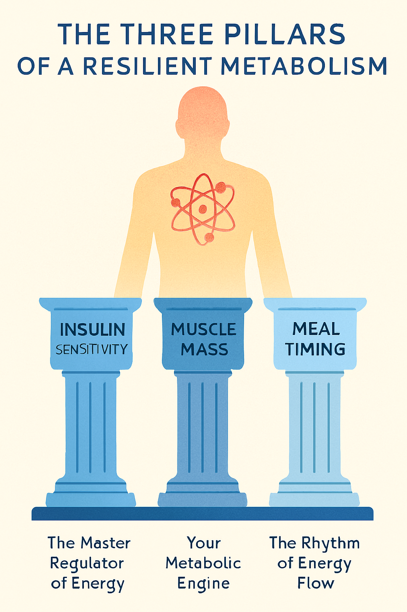
- Insulin Sensitivity: The Master Regulator of Energy
- Muscle Mass: Your Metabolic Engine
- Meal Timing: The Rhythm of Energy Flow
Let’s dive into each of these pillars and the practical, evidence-based strategies you can use to optimize them.
Pillar 1: Master Your Insulin Sensitivity
Insulin is a hormone produced by your pancreas. Its primary job is to shuttle glucose (sugar) from your bloodstream into your cells to be used for energy. Insulin sensitivity refers to how responsive your cells are to insulin’s signal.
High Insulin Sensitivity (Good): Your cells easily accept glucose, so your pancreas only needs to release a small amount of insulin to manage blood sugar. This is efficient and sustainable.
Insulin Resistance (Problematic): Your cells become “numb” to insulin. Your pancreas is forced to pump out more and more insulin to do the same job, leading to chronically high levels of both insulin and blood sugar.
Chronically high insulin promotes fat storage (especially around the abdomen), causes inflammation, and is a root cause of type 2 diabetes and other metabolic disorders.
How to Boost Insulin Sensitivity Naturally
The path to improving insulin sensitivity is not through extreme restriction but through consistent, smart lifestyle choices.
1. Prioritize Smart Carbohydrates:
The type and quantity of carbohydrates you eat have the most direct impact on your blood sugar and insulin.
- Choose Fiber-Rich Carbs: Dietary fiber, especially soluble fiber, slows down the absorption of sugar into your bloodstream, preventing sharp insulin spikes.
- Actionable Tip: Fill your plate with non-starchy vegetables (leafy greens, broccoli, peppers), legumes (lentils, chickpeas), and low-sugar fruits (berries, apples).
- Minimize Refined Carbs and Sugars: These are stripped of fiber and cause a rapid surge in blood glucose, demanding a large insulin response.
- Actionable Tip: Significantly reduce your intake of sugary drinks, white bread, pastries, candy, and most packaged snacks.
2. Incorporate Protein and Healthy Fats:
Both protein and fat have a minimal impact on blood sugar and help slow down digestion when eaten with carbohydrates.
- Protein: Eating protein stimulates glucagon, a hormone that counterbalances insulin.
- Healthy Fats: Fats from whole food sources provide sustained energy without spiking blood sugar.
- Actionable Tip: Build balanced meals that include all three macronutrients. For example, a chicken salad (protein + veg) with an olive oil dressing (fat) and a side of quinoa (fiber-rich carb).
3. Move Your Body Regularly:
Physical activity is a powerful insulin-sensitizer. Your muscles use glucose for fuel, and when they are active, they can take in glucose without even needing insulin.
- Aerobic Exercise: Activities like brisk walking, cycling, or swimming improve insulin sensitivity for up to 24-48 hours afterward.
- Strength Training: Building muscle (our next pillar) creates more storage space for glucose, permanently improving your metabolic capacity.
- Actionable Tip: Aim for a mix of activities: 150 minutes of moderate aerobic exercise and 2-3 strength training sessions per week.
Pillar 2: Build Your Metabolic Engine: Muscle Mass
If you still believe muscle is just for bodybuilders, it’s time for a paradigm shift. Skeletal muscle is one of the most metabolically active tissues in your body. It’s not dormant; it’s constantly burning calories, even at rest.
Why Muscle is a Metabolic Powerhouse
- It’s Your Primary Glucose Disposal Site: Over 80% of the glucose from your meal is taken up by your muscles. More muscle mass means more “passenger seats” for glucose, preventing it from circulating in your blood and being stored as fat.
- It Boosts Your Basal Metabolic Rate (BMR): Muscle tissue requires more energy to maintain than fat tissue. Each pound of muscle burns roughly 6-10 calories per day at rest, while a pound of fat burns only 2-3 calories. This difference adds up significantly over time, making it easier to maintain a healthy weight.
- It Improves Overall Functional Health: Strong muscles support your joints, improve balance, and preserve your ability to live independently as you age.
Simple Strategies to Build and Maintain Muscle
You do not need to live in a gym or become a powerlifter. Consistency is key.
1. Embrace Progressive Resistance Training:
This simply means gradually challenging your muscles more over time.
- Bodyweight Exercises: Start with squats, push-ups (on knees or against a wall if needed), lunges, and planks.
- Free Weights & Machines: As you get stronger, incorporate dumbbells, kettlebells, or gym machines.
- Resistance Bands: A fantastic, portable tool for building strength.
- Actionable Tip: Aim for 2-3 full-body strength sessions per week. Focus on compound movements that work multiple muscle groups (e.g., squats, rows, presses).
2. Eat Adequate Protein:
Protein provides the amino acids, the building blocks, your body needs to repair and build muscle tissue.
- Distribute Your Protein: Instead of one large protein-heavy meal, spread your intake throughout the day to maximize muscle protein synthesis.
- Good Protein Sources: Include eggs, Greek yogurt, chicken, fish, tofu, lentils, and lean beef.
- Actionable Tip: A general guideline is to consume 0.7-1.0 grams of protein per pound of your target body weight. For a 150lb person, that’s 105-150 grams per day.
3. Don’t Fear Carbohydrates (The Right Ones):
Carbs are not the enemy when you’re active. They replenish the glycogen stores in your muscles, which is the fuel you need for effective workouts.
- Actionable Tip: Time your intake of smart carbs around your workouts for energy and recovery.
Pillar 3: Harness the Power of Meal Timing
When you eat can be almost as influential as what you eat for regulating energy and metabolic health. Meal timing helps synchronize your body’s internal clocks, known as circadian rhythms, which govern your metabolism.
Time-Restricted Eating (TRE): A Practical Approach
Time-Restricted Eating is a form of intermittent fasting that involves consuming all your daily calories within a specific window of time and fasting for the remainder. The most common and sustainable approach is a 10-12 hour eating window, such as from 8 am to 6 pm.
Benefits of a Consistent Eating Window:
- Aligns with Circadian Rhythms: Your body is primed to digest food and produce insulin more efficiently during the daytime. Eating late at night goes against your natural biology and can impair insulin sensitivity.
- Promotes Metabolic Flexibility: It encourages your body to become adept at switching between burning glucose for energy and burning stored fat, leading to more stable energy levels.
- Reduces Overall Calorie Intake: Often, by shortening the eating window, people naturally consume fewer calories without conscious counting.
How to Implement TRE Without Extreme Measures:
- Start Simple: Begin with a 12-hour window (e.g., 7 am to 7 pm). This is manageable for most people.
- Listen to Your Body: If you feel unwell, adjust your window. This is not about starvation.
- Prioritize Meal Quality: A shorter eating window is not a license to eat junk food. The principles of whole foods, protein, and fiber still apply.
- Actionable Tip: Try to finish your last meal at least 2-3 hours before bedtime. This gives your digestive system a break and supports better sleep and overnight metabolic repair.
The Synergy of the Three Pillars
Notice how these pillars work together. Strength training (Pillar 2) builds muscle that improves insulin sensitivity (Pillar 1). A consistent eating window (Pillar 3) enhances insulin sensitivity, which helps your body better utilize the protein and carbs you eat to fuel your workouts and build muscle. It’s a virtuous cycle of metabolic improvement.
A 7-Day Action Plan for Better Metabolic Health
You don’t need to overhaul your life overnight. Start with one or two changes from this plan each week.
Monday:
- Action: Add one extra serving of vegetables to your lunch and dinner.
- Why: Instantly increases fiber intake for better blood sugar control.
Tuesday:
- Action: Go for a 20-minute brisk walk after a meal.
- Why: Uses muscle glucose, directly lowering post-meal blood sugar spikes.
Wednesday:
- Action: Do a 15-minute bodyweight workout (3 sets of squats, push-ups, and planks).
- Why: Signals your muscles to grow and improve metabolic rate.
Thursday:
- Action: Swap a sugary afternoon snack for a handful of nuts and an apple.
- Why: Balances blood sugar with protein, fat, and fiber, preventing an energy crash.
Friday:
- Action: Ensure you eat 20-30 grams of protein with your breakfast (e.g., 3 eggs, or a protein smoothie).
- Why: Kickstarts muscle protein synthesis and promotes satiety.
Saturday:
- Action: Try a 12-hour eating window (e.g., finish dinner by 7 pm and don’t eat again until 7 am).
- Why: Gives your digestive system a rest and aligns with circadian biology.
Sunday:
- Action: Plan and prep two balanced meals for the upcoming week.
- Why: Prep removes decision fatigue and sets you up for success.
Key Takeaways for Lifelong Metabolic Health
Improving your metabolic health is the single most impactful thing you can do for your long-term energy and disease prevention. Remember these core principles:
- Metabolic health is about energy efficiency and resilience, not just weight.
- Insulin sensitivity is key. Achieve it by eating fiber-rich whole foods, adequate protein, and moving regularly.
- Muscle is your metabolic security fund. Build and maintain it with consistent strength training.
- Meal timing matters. Align your eating with your circadian rhythm through a consistent, daily eating window.
- Avoid extremes. Sustainable, consistent habits always outperform short-term, restrictive diets.
By focusing on these evidence-based, practical strategies, you can build a metabolism that provides you with stable energy, sharp mental focus, and a formidable defense against chronic disease for life. Start with one small change today, and build upon it. Your future self will thank you.